
Rainbow Joyrider
The Rainbow Joyrider was designed and constructed by Frank Rainbow shortly after he had finished the Mark I Swallow Gadabout; it was intended to be a successor to the Gadabout, which was Britain's first post-war scooter. This machine was redesigned from the earlier Rainbow Sprite reviewed in the July 6th 1950 issue of the Motor Cycling magazine.
A number of novel ideas were incorporated into the Joyrider which was designed as a lightweight shopping machine for use by short-distance riders, principally women, so great attention was paid to keeping the weight down to only 112 lbs.
The twin tube frame is made of chrome-manganese aircraft specification tubing. From the steering head a pair of 1 5/16 inch diameter tubes run down below the engine and then up and back alongside the rear wheel, Cross tubes are MIG welded at intervals between the main tubes; the whole assembly proved exceptionally strong and light. Front forks are made from Reynolds 531 tube with rubber band suspension.
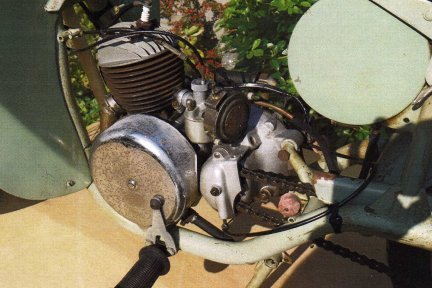 A 98cc Villiers 1F engine, with an easily removable cover, provided a maximum speed of 42 mph. A two-speed gearbox was built in and operated via a Villiers handlebar trigger-lever. Power was transmitted to the rear wheel via a chain drive on the left hand side of the machine. A specially designed unique annular silencer containing a spiral expansion chamber was claimed to give increased performance to the engine. A six pint tank is located under the Moseley "Float-on-air" pneumatic seat. Twenty inch wheels covered with flared aluminium mudguards gave a comfortable ride at a cruising speed of 30 mph.
Swallow Coachbuilding Company purchased the prototype and a complete set of drawings as their
next two-wheel project intended for production in 1951-52, but did not proceed with it.
The Joyrider and drawings were subsequently sold back to Frank Rainbow and the machine
was then used for his personal use.
| Specification |
| Engine |
Villiers Mk 1F two-stroke, Capacity 98cc.
47mm x 57mm.
Rainbow annular silencer. |
| Transmission |
Two-speed gearbox. Hand change
by handlebar trigger. |
| Frame |
Welded twin tube with no rear suspension. |
| Forks |
Single tube forks with rubber in tension suspension. |
| Wheel rims |
Front and rear 20" Dunlop chrome |
| Tyres |
2.50" x 20" |
| Fuel Tank |
Cylindrical steel, located under saddle, capacity 6 pints |
| Brakes |
Drum brakes - front controlled by hand lever, rear by foot pedal |
| Dimensions |
Wheelbase 44", ground clearance 5½", unladen seat height 24" |
| Weight |
112lbs. dry |
| Electrical |
Headlight 5½" diameter |
All the above images and text are used and provided for non-commercial research and educational purposes. If you object to the use of any of the material, please contact me immediately and the items will be removed.
